Project · Aug 2025 — Dec 2025
Yeaberry - Autonomous Harvesting Robot
Tecnológico de Monterrey
A cyber-physical strawberry harvesting cell combining a pneumatic soft gripper, in-hand RealSense D435 YOLO11-S RGB-D perception, UR3e control, and crop monitoring.
Collaborators
Highlights
- Designed and fabricated a three-finger pneumatic soft gripper with a center pad, adjustable mounting rails, universal UR3e coupler, and custom molds.
- Developed a YOLO11-S perception service using about 18,000 public images, 62,213 annotations, in-hand RealSense D435 depth, and PnP pose estimation.
- Implemented a configurable RoboDK/UR3e pick-and-place cycle with pre-pick, pick, post-pick, place, MQTT gripper commands, collision pre-checks, and visual success verification.
- Designed a two-layer electro-pneumatic control PCB with ESP32 pressure feedback and PWM control for the pump and valve.
- Integrated an ESP32/Raspberry Pi 5 crop-monitoring system with environmental sensors, MQTT logging, dashboard views, and Telegram alerts.
- Exceeded the project’s >75% success target in controlled tests using artificial strawberries across visible and partially occluded scenarios.
Media
 PDF
PDFDetails
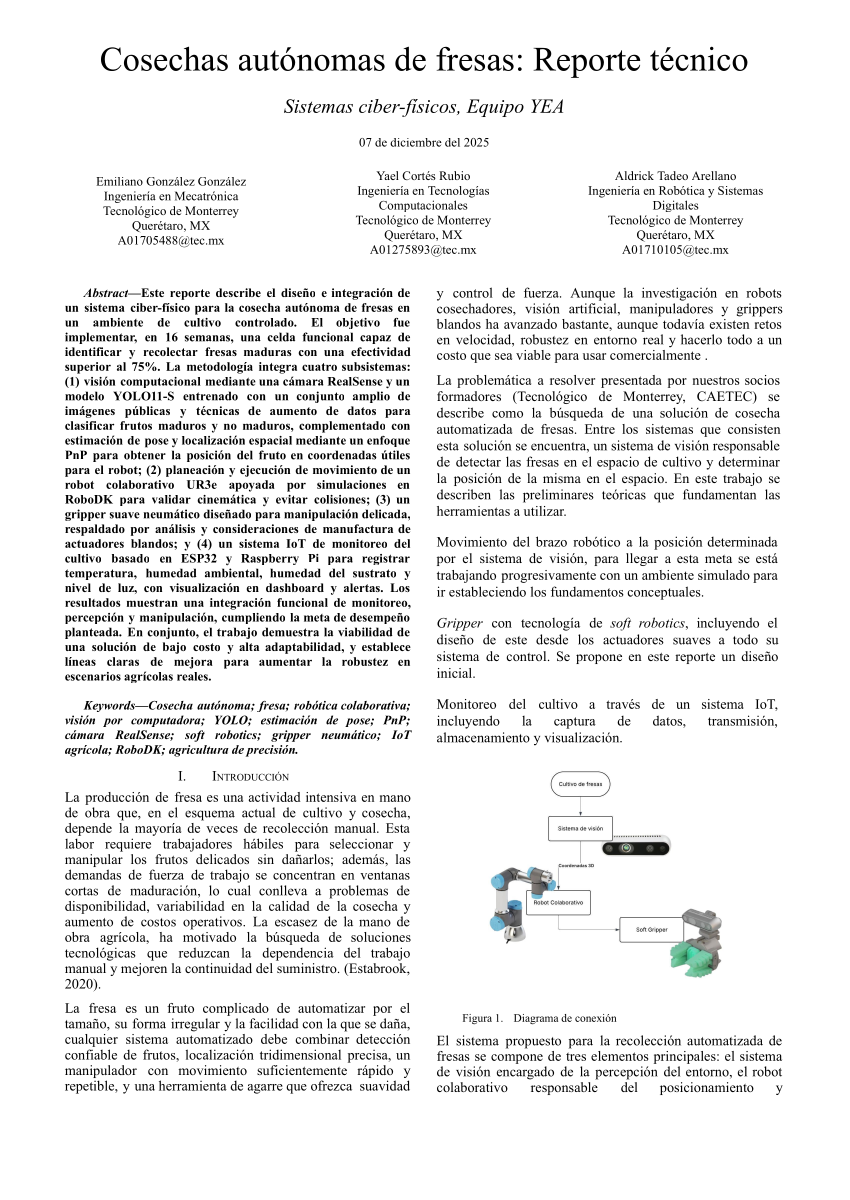
Yeaberry was developed over 16 weeks as a proof-of-concept cyber-physical cell for delicate strawberry harvesting in a controlled environment. The project addressed the full loop from detecting fruit and estimating its 3D pose to moving a collaborative robot, actuating a compliant tool, placing the fruit, and checking whether the pick succeeded.
Contribution
I designed the three-finger pneumatic soft gripper, its universal quick-change coupler for the UR3e, the actuator molds, and the soft center pad that keeps rigid parts away from the fruit. The actuator geometry uses curved, friction-enhancing fingers with two rows of pneumatic chambers so the gripper can conform to irregular fruit. I also used finite-element simulations to study deformation and iterated the manufacturing and sealing process in silicone.
I was responsible for the main vision and robot-integration path. The perception service combines an in-hand RealSense D435 RGB-D camera with a YOLO11-S detector trained on roughly 18,000 public images and 62,213 annotations. The model classifies ripe and unripe fruit; depth filtering and a PnP solve then turn each detection into a usable 6-DOF pose. A configurable confidence threshold of 0.65 was selected to reduce unsafe detections in the test setup.
System architecture
The control stack uses RoboDK as a digital twin and intermediary for the UR3e. A complete cycle moves through fixed photo and home poses, calculates pre-pick and pick targets from the detected fruit pose, sends MQTT commands to inflate and release the gripper, and applies calibrated post-pick motions to separate the fruit from the plant. Before physical execution, trajectories are checked in simulation for collisions. After placement, the robot returns to the photo pose and uses a second vision pass to verify that no ripe fruit remains.
The gripper is driven by an ESP32, a pneumatic pump, a 3/2 solenoid valve, a pressure sensor, MOSFET drivers, and a two-layer control PCB. Pressure/PWM characterization supported a PI controller tuned with gains of Kp = 7 and Ki = 2. In parallel, the team built an agricultural monitoring service around a second ESP32 and Raspberry Pi 5: a DHT22, LDR, and three capacitive soil-moisture sensors publish readings over MQTT, while the Raspberry Pi stores data and images for dashboard views and Telegram alerts.
Evaluation and lessons
The final experiments used artificial strawberries arranged to reproduce the size, position, and resistance of real fruit. The test matrix included an unobstructed ripe strawberry, a ripe fruit touching an unripe one with up to 20% occlusion, and a ripe fruit with at least 40% leaf occlusion. The report states that the integrated system exceeded the original success target of 75% for identifying and collecting fruit in the specified maturity state.
The result is a functional controlled-environment demonstration rather than a field-ready agricultural machine. Testing exposed false negatives under occlusion, model confusion with leaf-like backgrounds, inconsistent actuator sealing during fabrication, sensor-calibration issues, data loss after a Raspberry Pi failure, pump-induced vibration, and limited UR3e reach in the fixed setup. The report identifies a more representative greenhouse setup, a scenario-specific training dataset, more repeatable soft-actuator manufacturing, stronger data backups, and adaptive control as the next steps.