Project · Feb 2025 — Aug 2025
Computer Vision Based Autonomous Navigation
Manchester Robotics, Tecnológico de Monterrey
ROS 2 autonomy stack for a differential-drive Puzzlebot, combining OpenCV line following, custom YOLOv8 traffic-sign and traffic-light detection, encoder odometry, and parameterized crossing control.
Collaborators
Highlights
- Built and packaged a Python ROS 2 Humble workspace for the Manchester Robotics Puzzlebot with dedicated perception, command, control, and odometry nodes.
- Implemented a grayscale/OpenCV contour pipeline using proximal and mid-range camera regions to publish line centroids and crossing cues.
- Developed a custom YOLOv8 detector for three traffic-light states and six traffic-sign classes, with class-specific confidence thresholds and ROS topics for control.
- Connected line commands, crossing state, traffic detections, and encoder-based Pose2D odometry in a parameterized robot-control node that selects straight, left, or right paths and applies stop or slowdown behavior.
- Supported onboard, remote, and Gazebo simulation launch modes; physical deployment exposed 2.4 GHz Wi-Fi interference and latency as constraints on distributed ROS 2 communication.
Media
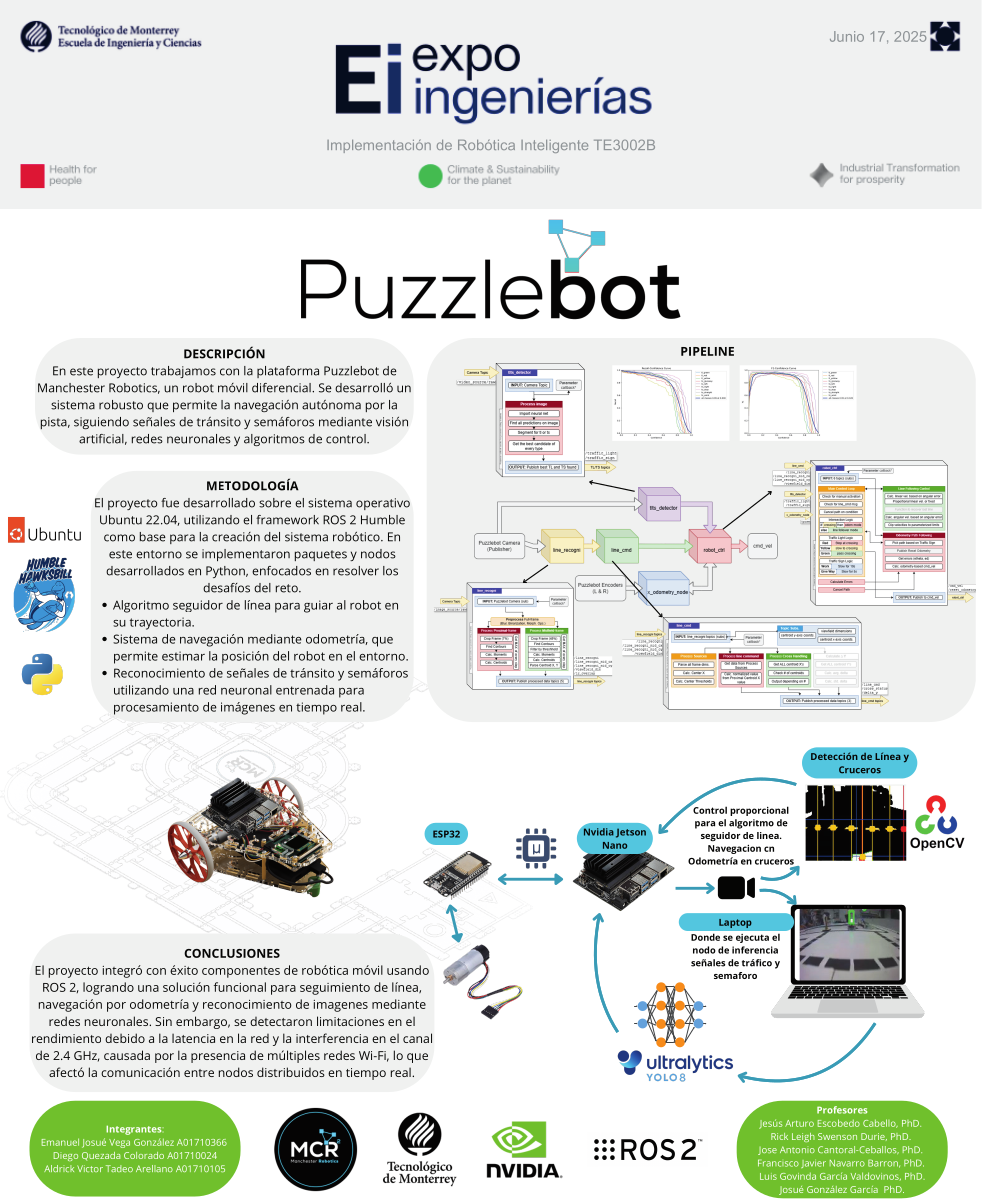 PDF
PDFDetails
System architecture
The project used Manchester Robotics’ differential-drive Puzzlebot to navigate a marked track autonomously. The GitHub repository packages the final challenge as a Python ROS 2 Humble workspace for Ubuntu 22.04, with dedicated nodes for camera processing, line recognition, command generation, traffic detection, control, and odometry.
The recommended onboard deployment runs line_recogni, line_cmd, robot_ctrl, and x_odometry_node on the robot side, while a local launch mode runs the traffic-sign and traffic-light detector separately. The repository also provides remote and Gazebo simulation launch modes for development and testing.
Perception and control pipeline
The line-recognition node converts camera frames to grayscale, applies Gaussian blur and inverse binary thresholding, then uses morphological cleanup and contour extraction. It evaluates proximal and mid-range image regions, publishing the detected line centroid, mid-range centroid arrays, and viewfield dimensions. A downstream command node converts the centroid offset into a normalized line-following command and detects crossings from the spatial arrangement of multiple centroids and their vertical spacing.
Traffic perception uses a custom YOLOv8 model loaded by the tlts_detector node. The model distinguishes three traffic-light states (tl_green, tl_yellow, and tl_red) and six traffic-sign classes for stop, give-way, left, right, straight, and work signs. Class-specific confidence thresholds are exposed as ROS parameters, and the selected detections are published as topics alongside an annotated image stream.
The robot_ctrl node combines line commands, traffic detections, crossing state, and encoder-based Pose2D odometry. Its parameterized angular controller reduces speed on sharper curves, stops for red lights and stop signs, slows for yellow/work/give-way conditions, and selects preset straight, left-turn, or right-turn paths at crossings. The odometry node filters wheel-encoder readings, integrates differential-drive motion, publishes pose estimates, and resets the local pose when a crossing sequence begins.
Deployment and evaluation
The system distributed responsibilities across an ESP32, an NVIDIA Jetson Nano, and a laptop running traffic inference. The combined stack produced a functional physical integration of line following, traffic-aware control, crossing navigation, and neural-network image recognition.
The report and repository document a practical deployment limitation: latency and interference on the 2.4 GHz Wi-Fi channel, amplified by nearby networks, affected real-time communication between distributed ROS 2 nodes. This constraint makes the project a useful example of how network architecture and execution placement can be as important as perception and control algorithms in a mobile robot.